Modal Olfactory Atmospheres: Experiential Design of Olfactive Environments
A modular olfactory experience with multi-sensory components
How do you experience light and sound in accordance to smell?
Questing the senses in what may seem ‘backwards’ – with sound and light following smell and not the other way around – was the point of my olfactory installation titled Modal Olfactory Atmosphere (MOA).
Staged in collaboration with the ITHQ (Institut de tourisme et d’hôtellerie du Québec) and ExperiSens, MOA saw participants enter a room filled with a scent and modulate light and sound in accordance to their experience of the scent.
MOA asked the participants to be part of a “performative sensory environment” and partake in the exploration of how we match the experience of designed smells such as perfumes with our understanding of light (hue/ intensity) and various sound elements (bpm, reverb, noise etc.).
As consumers of cultural productions, we know how aural and visual worlds are made, yet become uncertain about engaging with the olfactory dimensions we live and breathe in every day. Scent has profound effects on our sense of self and world, creating moods, tinging a room in a ‘color’ and toning our experience of space and time. MOA took both this design of environments and atmospheres as point of departure to develop the multisensory in a ludic manner.
Following the suggestion of “design makes things happen” (Potvin 2020), this project engaged with perfumes and scented products as designed objects that possess agency and affect a person’s ability to act and be acted upon in the environment (Canli 2020).
The sensory spheres of our agency can be grasped as atmospheres in the conception of German philosopher Gernot Böhme (2001, 2014). In this phenomenological philosophy, atmospheres “emanate” from objects and ephemera alike. In this, they ‘tinge’ or ‘color’ an environment, attract or repel subjects and change the very experience of time and space.
We may expect designed atmospheres, such as artistic installations and events, to appear as highly crafted experiences. Yet, daily objects and activities, including beauty products and cosmetics (Diaconu 2005) shape our experience of the world. A smell, emitted from a perfume tinges a room or a person in ‘a certain light’, altering our behavior within this space.
MOA created an immersive experience with agential performativity via multiple modalities adjusted by the perceiving subject (Rebentisch 2003, Fischer-Lichte 2014). Beyond pitting a person against a designed smell in a rigid visual and aural setting, MOA allowed for the visual and sonic layers of the installation to be altered by the press of a button and encouraged participants to reflect and express their experience of “made smells”.
Through this, MOA questioned the cultural formation of the senses (Reinarz 2014), when encountering scents in commercial settings. For instance, a mall would confront with predetermined images, sounds and settings designed to entice to buy into a feeling of a product at hand. This may include scents targeted for female and male audiences, propagating misnomers such as ‘oriental mystique’, ‘relaxation’ or ‘sophistication’. MOA tried to reconnect olfactory experience and encompassing affects to refine and allow for wider varieties of experiences and atmospheric formations in society, marketing, and design (Hsu 2020). Away from the powerless reception of products in hyper-designed and commercialized worlds, MOA tapped into the agency of the participants to alter the utility of sensory experiences to fit their needs (Benjamin 2007, Saito 2007, Tellenbach 1968).
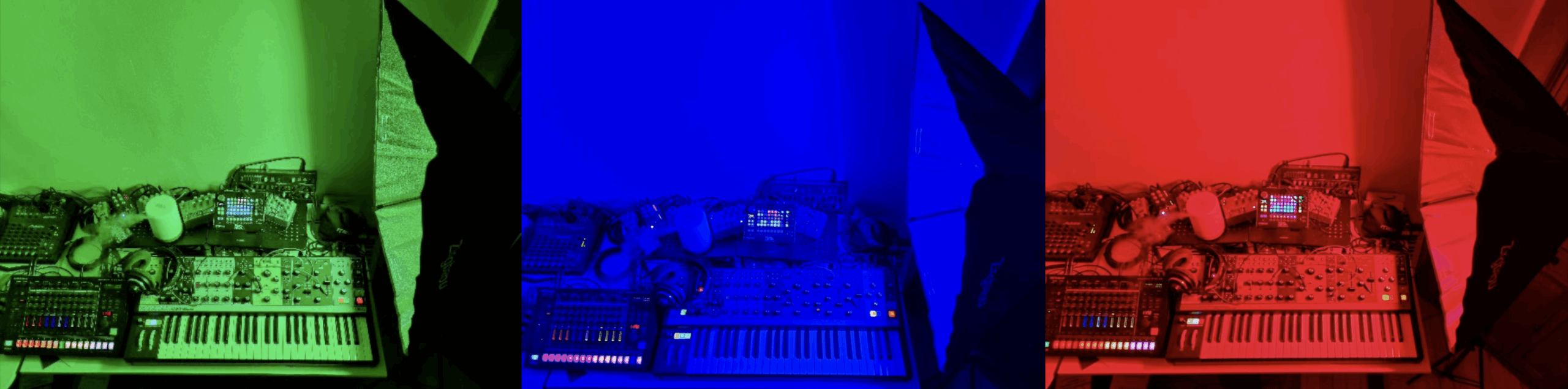
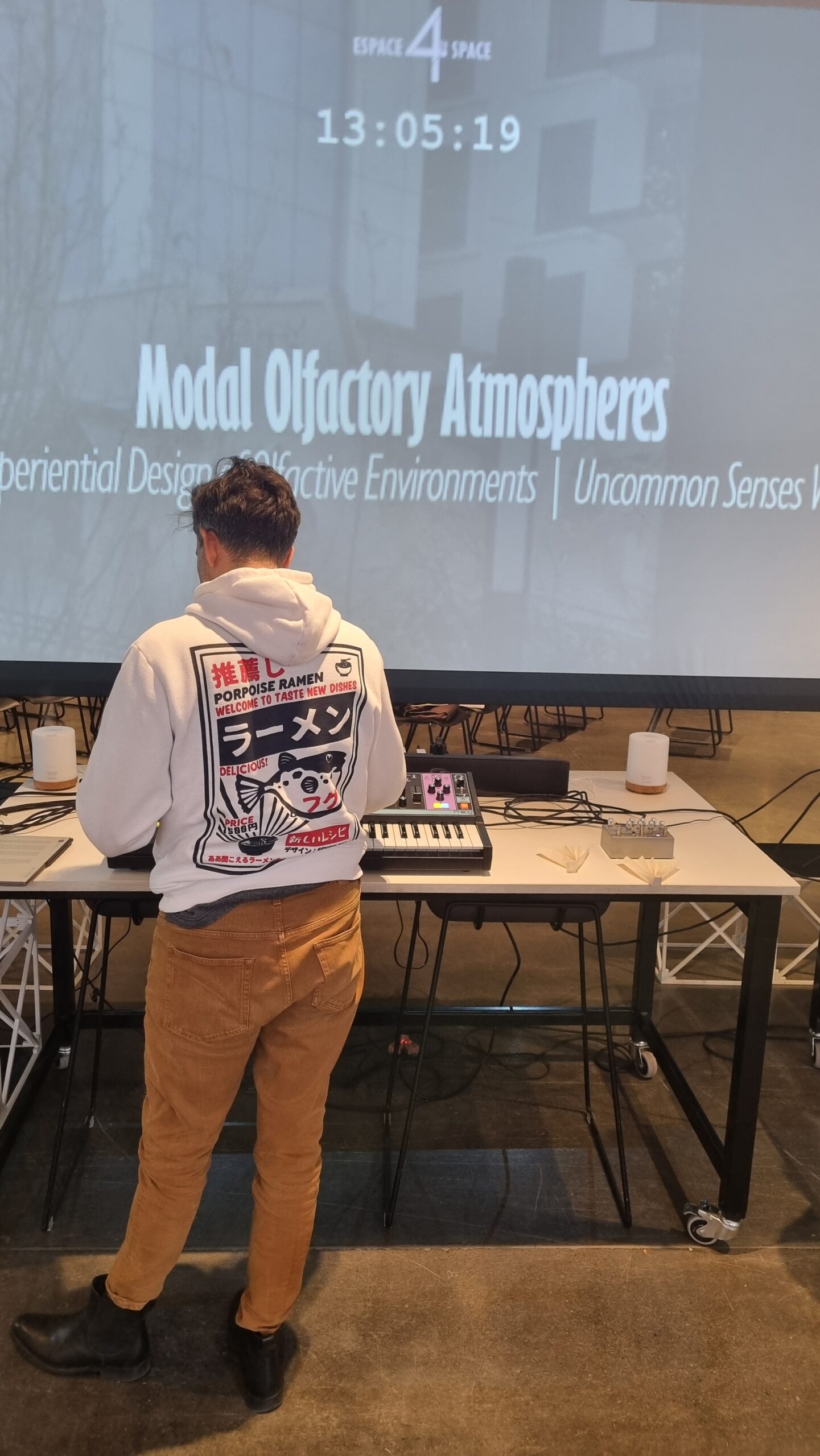
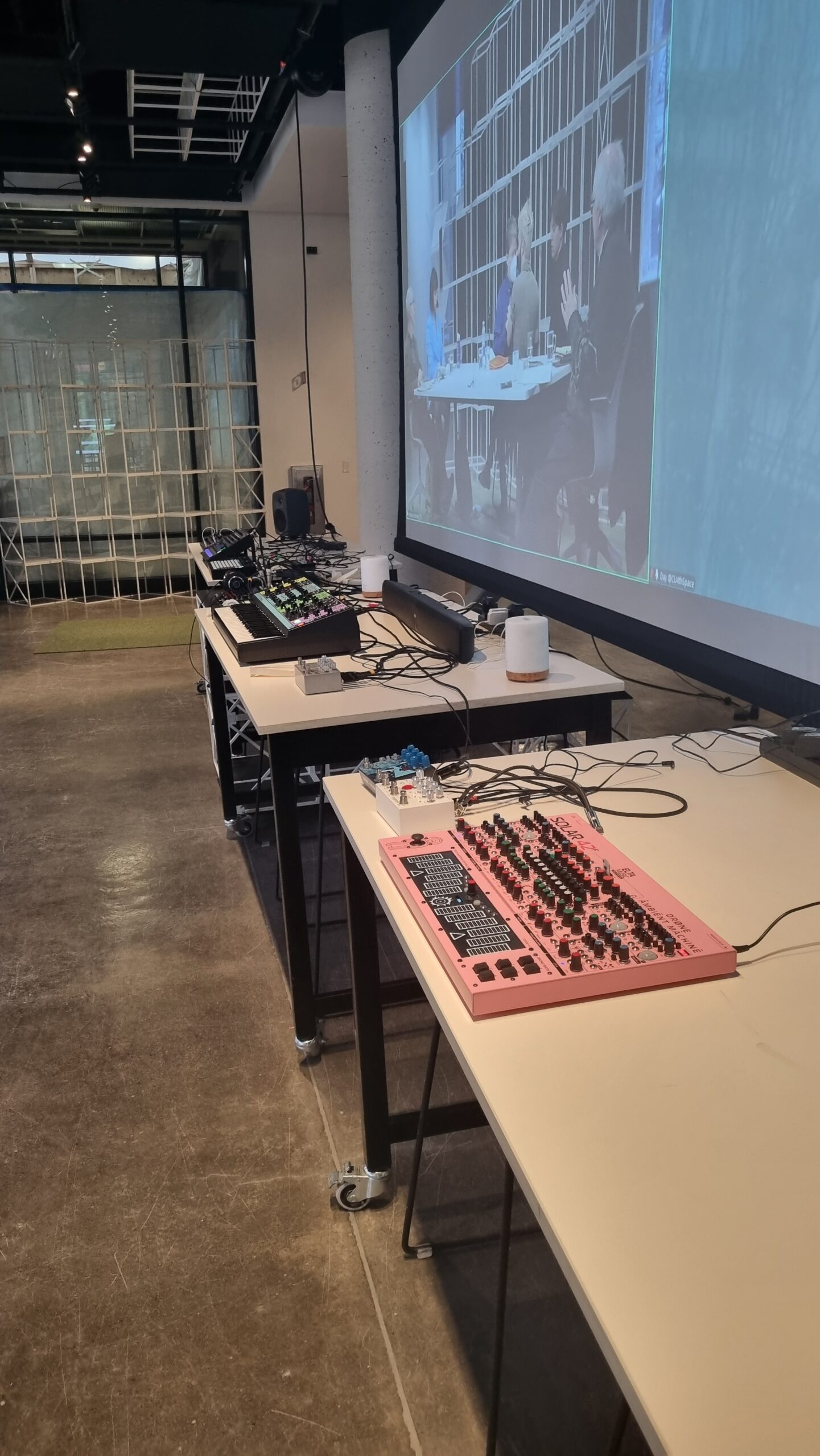
Participants were enabled to ‘play’ with a scented room by changing the ambient light and sounds in accordance to their smelling of the environment. The space was illuminated by a set of lights adjustable in hue and intensity. Additionally, a soundscape produced by a synthesizer and drum machine could be controlled in aspects such as pitch, speed, delay/ reverb intensity. The modulation of both light and sound were open to everybody and instructions on how to use the means to alter the atmosphere of the environment were given in tandem to experiencing the scent. No information on the scent, its notes or compositions were given beforehand.
Thank you to the participants that came around and brought the time to be questioned on their experiential choices, connections, and dissimilarities to marketed sensory experiences. Drawing from sensory scholars to those with curiosity and others that heard me doing a short industrial exercise when I thought nobody was listening, the resonance to the installation doubling as a sensory experiment was much appreciated and made me think about olfaction in new ways.
A video of a dry-run of the experience can be found here: The one thing the video cannot reproduce is the smell of Ex Idolo’s Ryder. Keen eyes may notice that one of my synths was on standby during the video, one of the hazards of working after-hours when the kid is asleep.
A video and description of MOA’s staging at Uncommon Senses V can be found here.
MOA was staged using:
Two softbox lights,
Two scent diffusers,
Three perfumes: Ryder by Ex Idolo
Harvest Mouse by Zoologist
Black Afghano by Nasomatto
Alesis Multimix 8
Moog Matriarch
Roland TR8S
Old Blood Noise Endeavors Dark Light
Empress Effects Reverb
Empress Effects Echosystem
Empress Effects Bass Compressor
Empress Effects ZOIA
Korg Volca FM2
Conductive Labs NDLR
Jayanthan Sriram is 2025-26 Public Scholar at Concordia University, Montreal, Canada, a member of the Centre for Sensory Studies and PhD candidate in the Interdisciplinary Humanities PhD Program. He serves as the coordinator for the Explorations in Sensory Design research team and is the assistant to the editor of the journal The Senses and Society. His research, funded by the German Academic Scholarship Foundation, promotes a new aesthetics of olfaction as aistethics of perfume and functional scenting to grasp the social and political dimensions of sensory experiences and the role of aesthetic labor in them. Jayanthan’s recent work has been featured in Alabastron (2024) (edited by Nuri McBride and Saskia Wilson-Brown), The Routledge History of the Senses (2025) edited by William Tullett and Andrew Kettler), Work and Smell (2025) edited by Frank Krause and Art and the Working Class (2025).