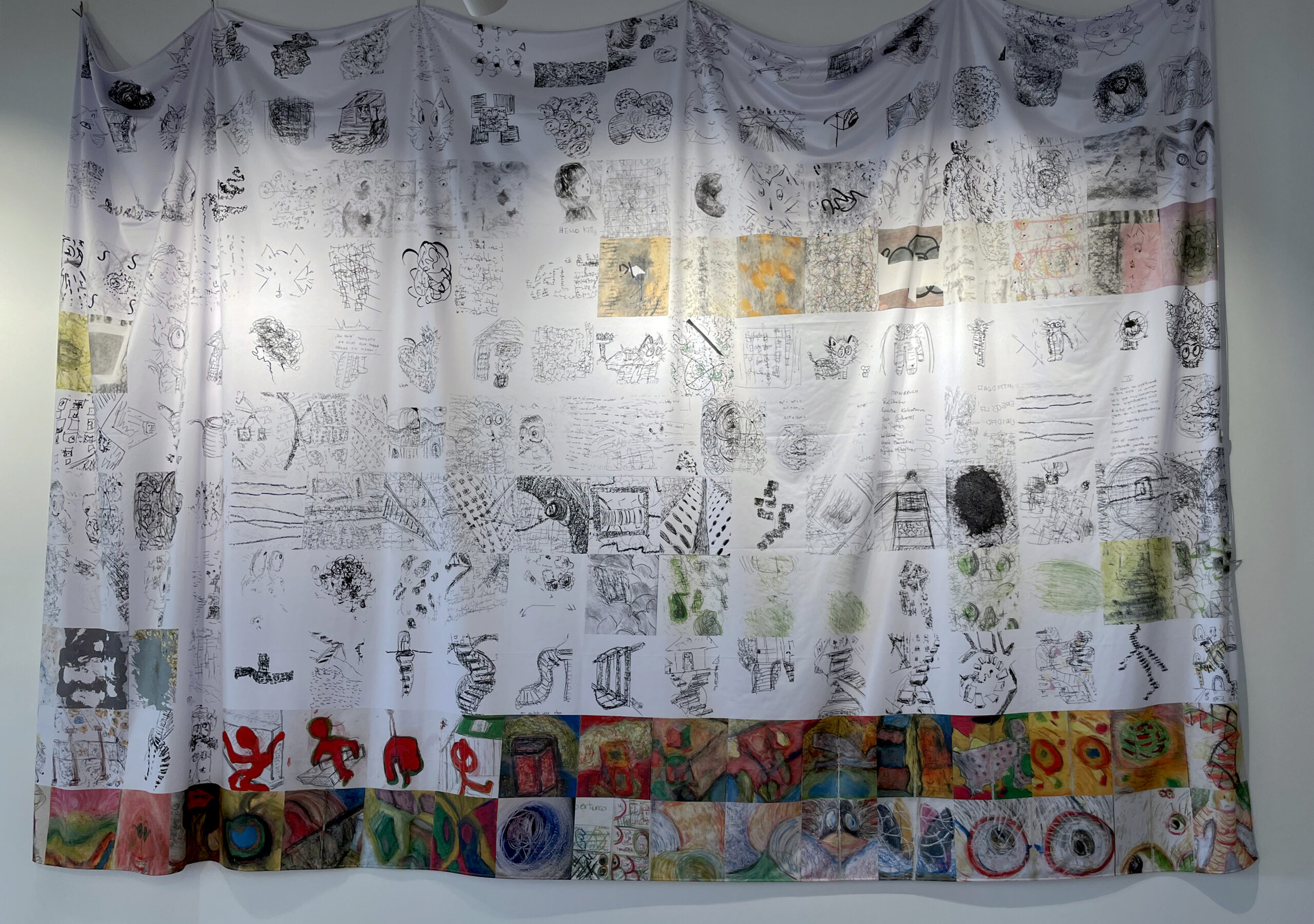
Taking Sight Out of the Eyes: An Aesthetic Epistemology of Low Vision
Brígida Maestres (artist) & Angela Bonadies (curator)
Dates: March 10 – July 10, 2026
Location: Universitat Oberta de Catalunya (UOC), Building U, Floor 0, Carrer del Perú 52, Barcelona
This exhibition holds a special connection to our community, as Brígida Maestres was a Visiting Scholar at the Centre for Sensory Studies between September 10 and December 10, 2024. Her work during this period was featured in the article “Wandering into the periphery“ by The Link (Concordia University’s newspaper), which highlighted her research on “The Wandering Eye” and her unique aesthetic interpretation of Montreal’s urban landscape.
Six walls are arranged in a trapezoidal space to compose a linear path drawn by the author with the purpose of shifting sight away from the eyes:
- Wall 1: The Curator’s Perspective “This exhibition is a journey in which the act of looking goes beyond the eyes, offering a mapping of the outburst and rebelliousness of objectivity through the aesthetic experience of Brígida Maestres. Here, vision is emancipated and detached; it plays hopscotch, it jumps, it is curious, it invents forms and sensitive knowledge, and brings the body to life as a compendium of animistic limbs that challenges us: When did vision become trapped in the impenetrability of an eye, in the sparkling of the physiology of its parts, in the blink of the pupil, in the impact on the infinite network of the retina, in the transmission through the optic nerve, in the yellow stain, in the blind spot?”.
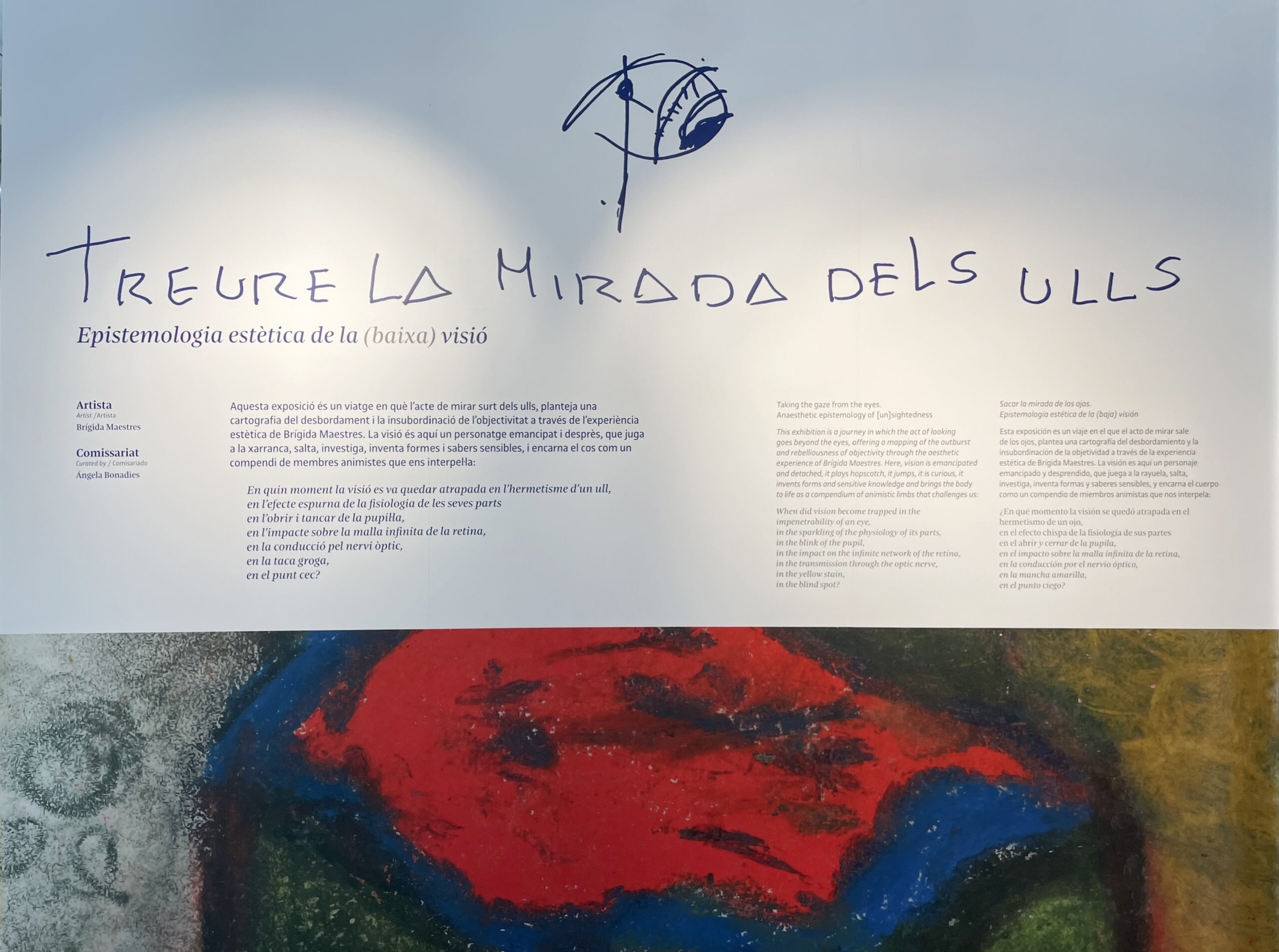
- Wall 2: Revelation Also, a way of rebelling against those who decide who is able and who is not. This epiphany came about in a dialogue between friends, in which Maestres became aware and created a counter-discourse triggered by the aesthetic experience and by her anger at the diagnosis of her vision as “residual”. How can I “show” what I say I see? How can I express that every type of vision is complete?. Brígida: By the way, could you take a photograph in which the image is only clear from some angles, and blurry or pixelated from others?. It is the first of our photos which will only act as a starting point because it is so obvious.
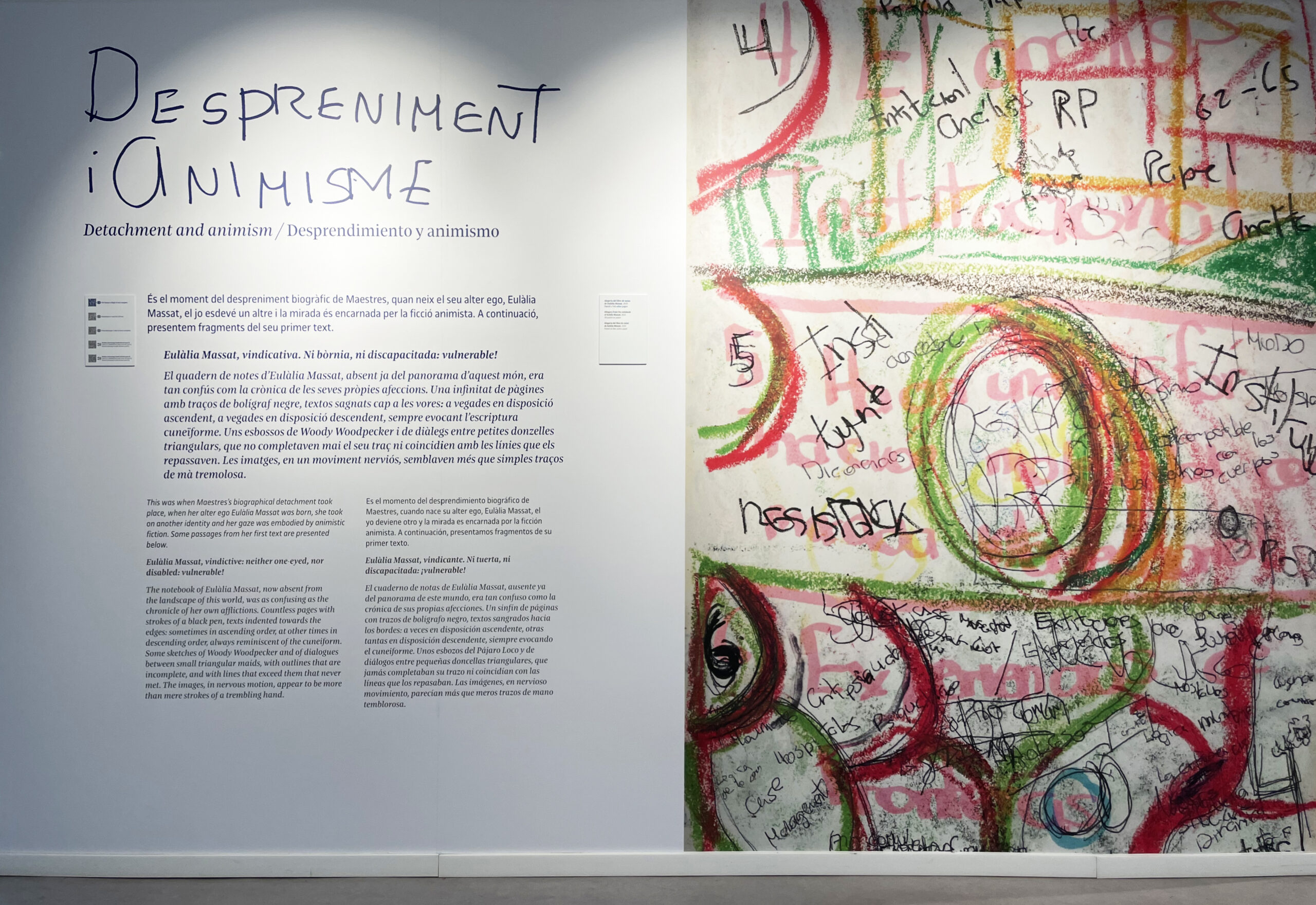
- Wall 3: Detachment and Animism This was when Maestres’s biographical detachment took place, when her alter ego Eulàlia Massat was born ; she took on another identity and her gaze was embodied by animistic fiction. Some passages from her first text are presented below. Eulàlia Massat, vindictive: neither one-eyed, nor disabled: vulnerable!. The notebook of Eulàlia Massat, now absent from the landscape of this world, was as confusing as the chronicle of her own afflictions. Countless pages with strokes of a black pen, texts indented towards the edges: sometimes in ascending order, at other times in descending order, always reminiscent of cuneiform. Some sketches of Woody Woodpecker and of dialogues between small triangular maids, with outlines that are incomplete and with lines that exceed them and never met. The images, in nervous motion, appear to be more than mere strokes of a trembling hand.
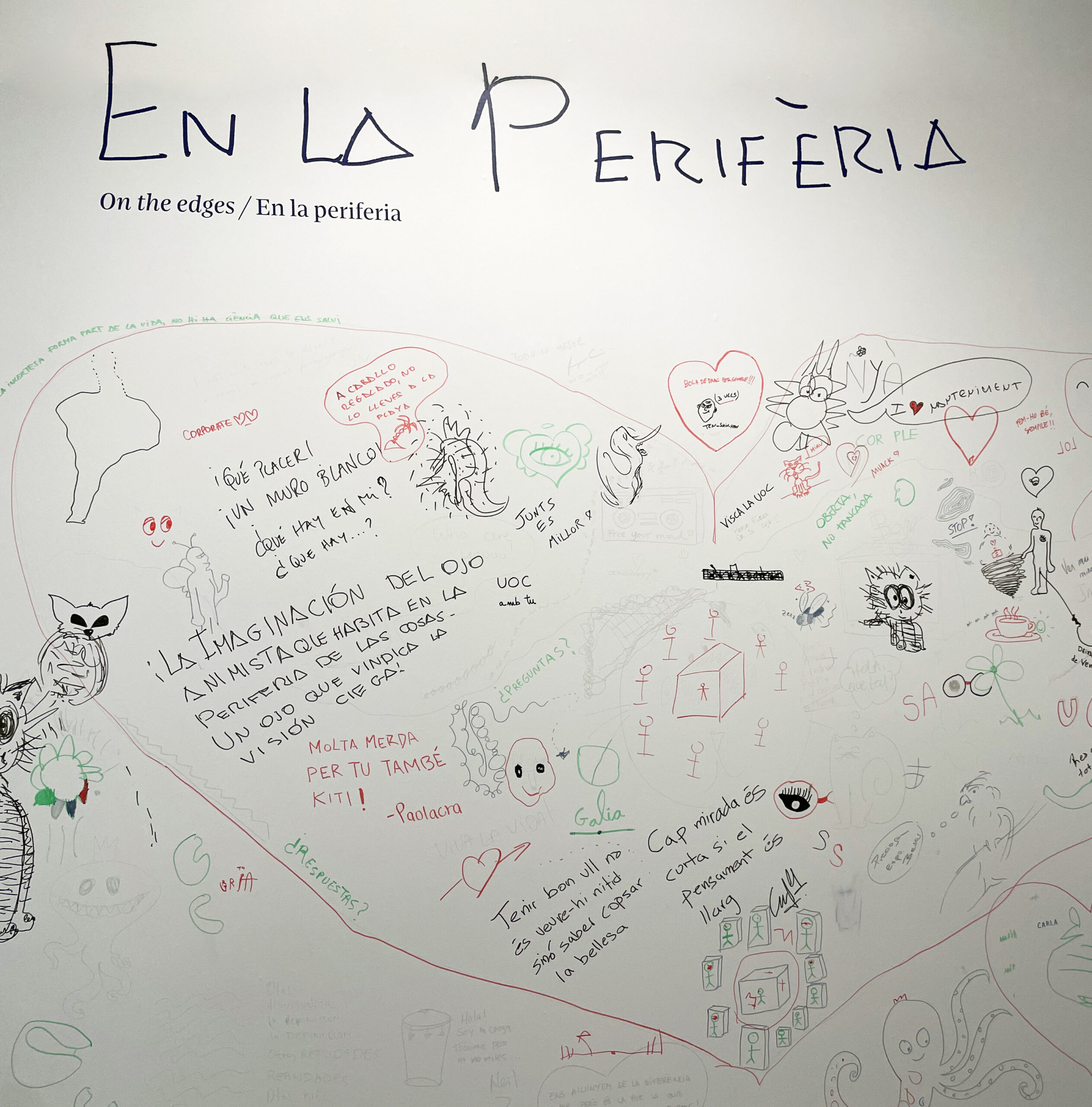
- Wall 4: On Periphery.
- Wall 5: The Wandering Eye The wandering eye presents itself as it really is; it recognizes itself as a fugitive, outside the prison of normalization: drifting with expressive imagination and action. The eye charts a map, a territory full of tangled figures in which object and subject come together.
- Wall 6: Outside After a lengthy wandering on the edge, everything begins to take shape. The image, detached and animated, crashes against the wall and jumps into the space of matter, of relief, of manipulation, of touch: the drawing comes to the surface. Where some “see what they see”, the wandering eye pierces and penetrates, it sees further away and more closely: with its gaze settled on the extreme, it shows us the blindness of normality. If “power” in its immense abstraction represents what “is taken for granted”, Brígida Maestres’s movement dismantles it and breaks loose from its mandate: it wanders through its blind spots, its gaps in meaning, its sinuous shadows, and outlines a poetics of possibility.
Once the concern has been formulated, the exhibition’s central question is the production of reality: how much a body diagnosed with low vision contributes to it, and in what way the materialization of this vision into objects—visible, tangible, beautiful—bursts into normalcy and virtualizes it as an effect of a context of domination that separates, differentiates, and hierarchizes bodies. The animist vision, which is the resignification of low vision within the exhibition, vindicates itself as a participant in the construction of the real and, therefore, shatters the normalcy of the illuminated, centered, and focused vision that establishes itself as hegemonic.
Consequently, the experience of moving through the exhibition acquires dimensions of ruptures and reifications of meaning:
- It misaligns the blindness/disability binomial.
- It cracks aesthetically the subject/object duality by opening the phenomenological field of the gaze as an interstice.
- It proposes an ontology of the real based on the movement of the nystagmic vision reflected in the pieces, and on seeing through scars as an image of the mesh.
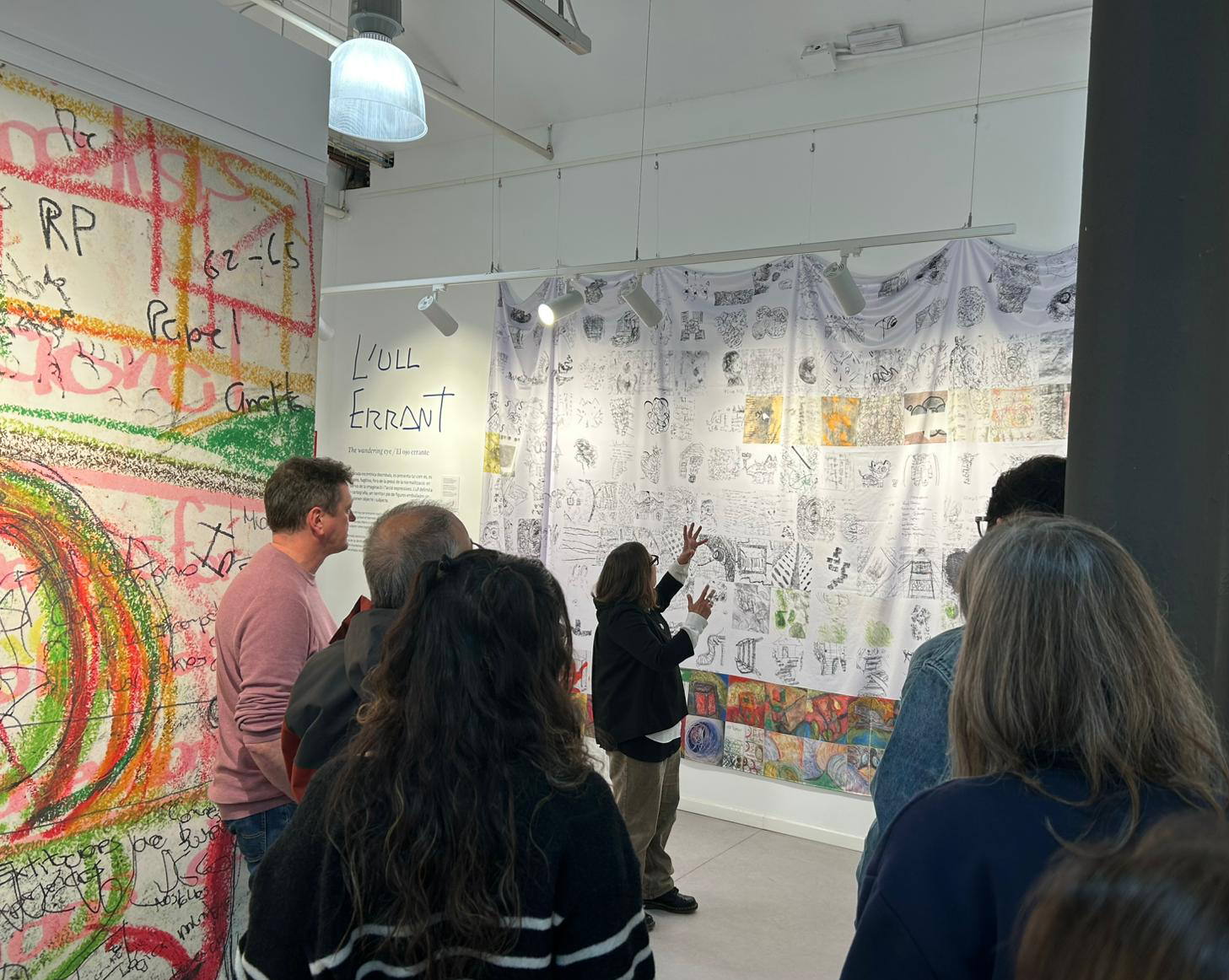
More than 100 people attended the opening on March 10th. As shown in the invitation, the timetable included a symposium titled “Dialogues in the Periphery” in which, alongside two other scholars, we performed a decentered and obscure talk combined with live drawing, puppets, and blind readings. The participation of the public included two animist attendants. It was amazing!